
Calvin University is introducing a new Aerospace Engineering concentration, which will focus on the building and launching of CubeSat satellites. On Tuesday, March 17, the engineering department held a CubeSat program kickoff, covering the details of the program, including how it was founded, who will be a part of it and a general timeline for the development of the program.
President Greg Elzinga started the kickoff by introducing attendees to the donors who will fund the CubeSat program. He shared that Michael and Wendi VanWoerkom — both Calvin graduates — strategically gave to Calvin. Their giving will support the long-term growth of the university’s new aerospace engineering concentration, “positioning Calvin University to become a national leader in Aerospace Education within Christian higher education in this country,” Elzinga explained.
Elzinga shared that Michael and Wendi VanWoerkom both earned their engineering degrees at Calvin. Michael went on to earn an advanced degree at the University of Michigan, later founding the aerospace company ExoTerra Resource. He also spent 13 years at Lockheed Martin as the original Mechanical Lead for the Orion Spacecraft, among other roles. Wendi currently works for Muller Engineering Company in Lakewood, Colorado. According to Elzinga, “their gift will fund advanced laboratory equipment, create the VanWoerkom Aerospace Lab, and establish the VanWoerkom endowed professorship dedicated to space systems, hands-on student projects and external research funding.”
The Aerospace concentration officially joined Calvin’s engineering program in the fall of 2025 with full lab implementation targeted by 2027. “The new VanWoerkom Aerospace Lab will occupy renovated space within Calvin’s engineering building, and that work has already started,” Elzinga said.
Michael VanWoerkom spoke at the kickoff, introducing what a CubeSat is, why students should be on a CubeSat team, what the program needs to succeed and what the near future will look like. Last name reference VanWoerkom in this article refers to Michael VanWoerkom.
VanWoerkom described a CubeSat as a 10cm3 miniature satellite that had previously been used as a teaching aid for satellite basics. The first CubeSat was launched in 2003, and between 30 to 50 are now launched by universities every year, according to VanWoerkom. Each CubeSat is measured in 10x10x10 centimeter units, ranging from 1 unit to 12 units.
Calvin’s CubeSat program will focus on designing and building these satellites to launch into space. VanWoerkom shared that “CubeSats ride up [to space] on a ride share.” Scientists created a ride share system where satellites are stuck to rocket fairing to fill up any possible extra space on rockets, making it cheaper to send satellites into space.
When discussing why students should be part of a CubeSat team, VanWoerkom argued that being a part of a CubeSat team “will teach you more about engineering than all classes combined … it puts book knowledge to work in a real environment.” He also stated that employers look for real project experience, including programs like CubeSat.
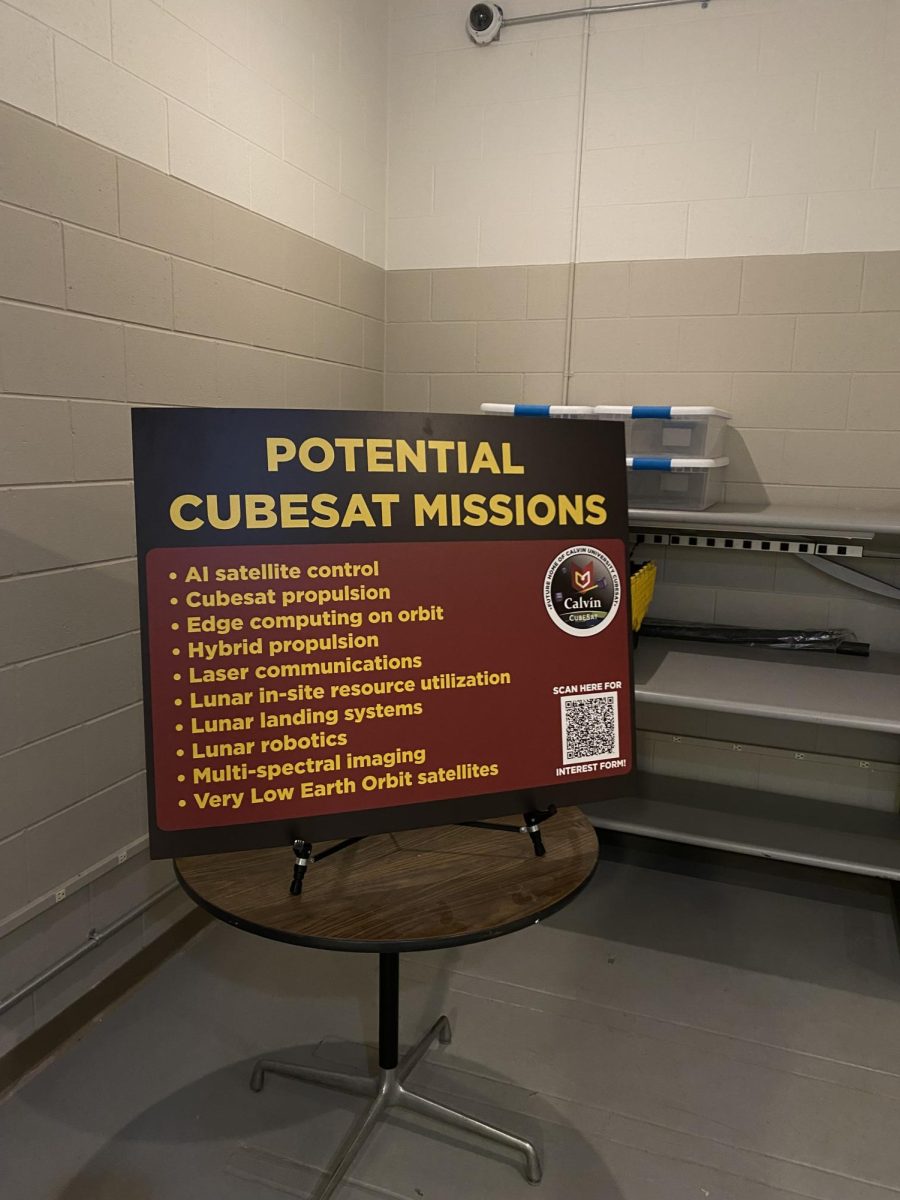
VanWoerkom continued by explaining that the program is student-led. The program needs students to lead, recruit, raise money, design, build, test and launch. There will be professors and former students to help guide current students, according to VanWoerkom. Students involved in the program will decide what each satellite mission will do, whether that be taking pictures or using the satellite for communication, among other mission possibilities.
Students from all across campus will have the opportunity to be a part of producing a CubeSat satellite. VanWoerkom shared that they could use anyone from mechanical and electrical engineering majors, to computer science and software majors, any science majors, to business majors for fundraising and finance. VanWoerkom stated, “This is something that can stretch across the entire school … we could even use art majors for design aspects.”
VanWoerkom shared that students in the program will have access to an aerospace lab, clean rooms for the assembly of CubeSats, thermal vacuum chambers to mimic space conditions, electrical ground support equipment and a vibration table which will allow them to simulate the launch of a rocket. There will also be a mission control center for satellite operations.
In order to continue the success of the program, it will need further sponsors. VanWoerkom stated, “Our whole thing here is not one and done … every year we’re going to [work on another satellite].” For this, the program needs sponsors — the development of a CubeSat can cost anywhere from 50 to 500 thousand dollars. One of VanWoerkom’s goals for the program is to eventually be sponsored by NASA, who pays for eight to 12 university CubeSat launches per year. VanWoerkom shared, “As we move forward, there will be other people to step in and help … and that will put Calvin on the map of aerospace programs.”
Looking to the future, VanWoerkom shared that the next step is picking student leaders who will be willing to train future student leaders. After that, steps include a combination of brainstorming a mission, recruiting students to help with the project, setting up the lab — which is projected to be completed by September — and getting started on the first CubeSat. The program intends to brainstorm and choose a mission by the end of summer 2026. Following that, the first CubeSat design is aiming to be done by August 2027, with the first build done by May 2028 for an August 2028 launch, according to VanWoerkom.
VanWoerkom also shared that the CubeSat program will involve work over the summer, and that “there are hopes for summer internships coming out of this.” Teams that work on the satellite may be as small as 12 students, but will likely have more than that, as stated by VanWoerkom.
Students in the engineering program expressed their excitement for the CubeSat initiative. Juan Moon, President of Calvin’s American Institute of Aeronautics and Astronautics (AIAA) club stated, “This is a very big opportunity. … It’s a bigger project than what I’m used to and it’s very exciting.” If he is involved, he hopes to be part of the leadership team that works to raise up more student leaders in the program.
Ryan Deaton, president of Calvin’s HAM Radio club, stated that “it’s really exciting. It’s something that a lot of universities are doing, but I don’t think a lot of universities will be able to do as well.” He emphasized that this is one of the first times a Christian university has done something like this and that the CubeSat program “offers a lot of opportunities for different students with a lot of different skills.” He hopes to work with telecommunications within the CubeSat program.
Elzinga shared, “This gift from Michael and Wendi VanWoerkom is transformational for Calvin. It allows our students to engage directly in aerospace innovation — from designing and building a CubeSat to working in advanced labs — while being formed by a Christ-centered education that emphasizes purpose, responsibility and service.”
Calvin University’s new CubeSat program represents a major step forward in hands-on, collaborative aerospace education, positioning students to gain real-world experience while advancing the university’s growing presence in the field.