
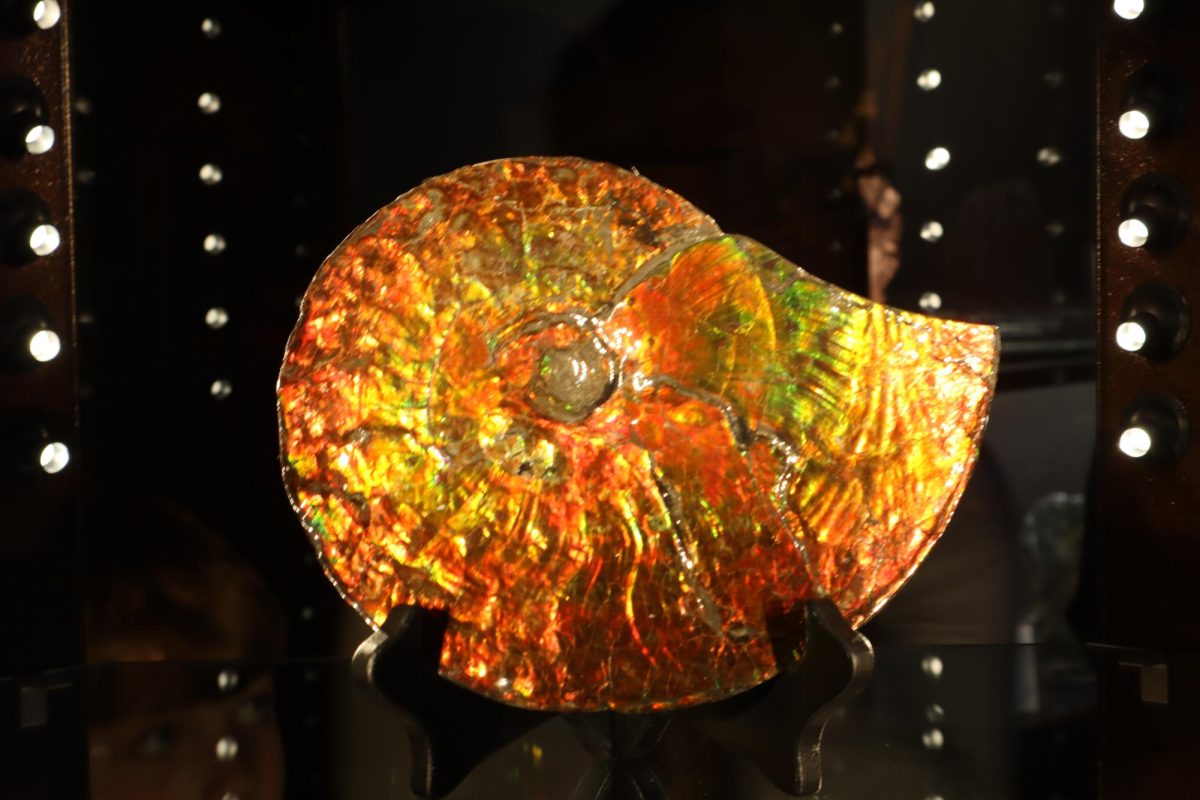
On Nov. 14, the Bruce Dice Mineralogical Museum unveiled an ammolite fossil, as well as a painting by student Elizabeth Ayers — commissioned to honor the museum’s rarest fossil of an octopus.
The unveiling event, “Diving into Deep Time: Life in Cretaceous Seas,” featured a GEO Seminar where Dr. Chris Walley focused on Lebanon, the unveiling, a fossil exhibit and a short film, with catered food for guests.
According to Kent Ratajeski, director of the Bruce Dice Museum, Calvin alumnus Bruce Dice donated a number of fossils to Calvin, many from Lebanon, twelve years ago. This donation is what started the Bruce Dice Mineralogical Museum. Although Dice passed away two years ago, the museum has been supported by the Dice Foundation, receiving donations that are used “to pay a student scholarship,” according to Ratajeski. Some of the money is also used for acquisitions of new fossils, which is how the Dice Museum obtained its new ammolite fossil.
Ratajeski noted that the Dice Museum holds over 500 geological specimens—which includes minerals, rocks, and fossils—with about 300 on display. However, the event on Nov. 14 specifically focused on marine fossils from the Cretaceous Period, featuring the museum’s collection of marine fossils from Lebanon.
The ammolite fossil
According to information from the Dice Museum, ammolite is a rare gemstone formed from the fossilized shells of ammonites, ancient marine mollusks that lived during the Late Cretaceous Period, about 70 million years ago. Ammonites went extinct at the end of the Cretaceous Period and are composed primarily of aragonite, the same component of pearls, which displays beautiful iridescent colors. Ammolite is found predominantly in the Bearpaw Formation of southern Alberta, Canada.
Ratajeski informed Chimes that the ammolite fossil is special because of its color. He explained, “It’s basically a layer of fossil that just happens to have the right thickness [of] layers of minerals in it. So … when light reflects off of it, the light rays interfere with each other on the way out, [and] you get this incredible color.” Ratajeski described this interference of light rays as structural color.
During the Cretaceous period, there was a seaway going “all the way from the Arctic Ocean to the Gulf of Mexico,” Ratajeski told Chimes. Alberta, Canada, is right in that area, where ammonites would have resided. This was during a period of greenhouse climate, characterized by warm temperatures with high sea levels, according to Ratajeski, and because of higher sea levels, they flooded the continents. Ratajeski stated, “these shallow seas … just exploded with life.” Ratajeski added that the closest living thing we have to ammonites is the Chambered Nautilus.
Ammolite is also often used in jewelry, so the Dice Museum will be featuring an ammolite necklace to accompany the fossil.
Commissioned painting
Ayers, a junior pursuing a Bachelor of Fine Arts with a literature minor, was approached to commission a painting for the Dice Museum’s octopus fossil over Christmas break of the 2024-25 school year. With months of preparation and acquiring materials, Ayers started working on the painting three months ago.
The Dice Museum features a fossil of an octopus, which is housed with two other fossils, all from the Haqel and Hjoula localities in Lebanon. The octopus lived approximately 100 million years ago. The closest living relative to the fossilized octopus is the vampire squid, according to the museum.
According to Ayers, the point of the commission was “to paint the landscape of where the octopus would have lived … a general sort of shallow seabed landscape.” Ayers added that, by complementing the fossil with a painting, it makes the museum more interactive and helps guests relate to the specimens more. Ayers noted that the presence of the painting helps guests appreciate the beauty of the fossils.
Ayers noted that the plants and fish in the painting are “realistic to the time period in which it’s supposed to be set.” Ayers communicated extensively with Ratajeski to ensure that her painting was accurate, but was able to explore creative interpretation with the movement and lighting of the painting.
The painting was created with tranquil landscape features, and Ayers stated that it ended up being more of an empty ocean scene, which created an atmosphere that is “peaceful [and] very open.” In regard to features, Ayers informed Chimes that the lighting effects “indicate the depth of the water,” which would be very specific to where the octopus would have lived.
Ayers added that a lot of her work is naturally inspired, and because of her appreciation for nature, painting natural landscapes is “the way I worship,” and that by painting she can bring that appreciation into everyday life. She stated that being able to paint such an ancient specimen “gives me a greater appreciation for how old the world is and how amazing creation is.”
Art and science in collaboration
When asked what inspired the decision to commission an artist to create a painting alongside a fossil, Ratajeski told Chimes that after experiencing museums that featured art and fossils, that art “just brought the past to life … so I wanted to do a little bit of that here.” However, he didn’t want to copy and paste an online painting, but wanted to get other areas of Calvin involved, or in this case, the art side of Calvin.
Ratajeski noted, “It’s hard to visualize what ancient environments look like, but that’s where the art can really help,” when emphasizing the importance of why art and science should collaborate. Ratajeski added that art can bring science to life because “it helps to have a picture in your head,” heightening the experience of science.
For Ayers, combining art and science can help people understand natural history in new ways. Ayers told Chimes, “You flip open a textbook for any class and there’s going to be illustrations. It doesn’t matter if it’s history or anatomy … [there are] illustrations that are a part of your learning experience.” Ayers argued that artists have an important role in making information accurate so it can be better learned, noting that when reading a textbook, you “use your eyes before you read the words.”
Ayers hopes it can be conveyed to students that “now more than other times it’s important to unify Calvin and talk about how our departments need each other.” Ayers sees the necessity of valuing the skills each department at Calvin has. According to Ayers, “art has the ability to draw people together,” and she hopes that her painting can not only help unify science and art, but also members of the university and the surrounding community.

Together, the new fossil and commissioned painting highlight the value of connecting scientific research with artistic insight, and Ratajeski hopes this partnership serves as a model for future interdisciplinary work on campus.