


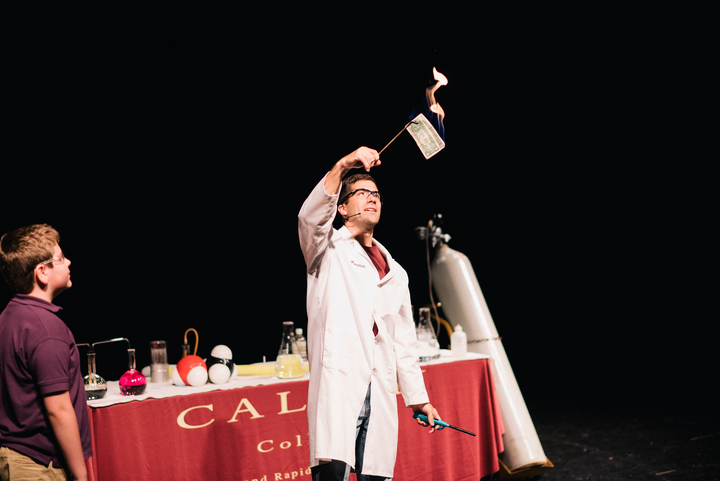
Professor Chad Tatko of the chemistry and biochemistry department was elected to the position of Faculty Senate chair last week after voting concluded over the Easter weekend. The win was announced by email to faculty on Tuesday, April 7.
The Faculty Senate chair serves as both the head of the Faculty Senate and as the faculty representative to the President’s cabinet for a three-year term. Tatko will assume his first term this summer, following outgoing chair Professor Dave Koetje.
Tatko comes into the role with 20 years of experience as a professor at Calvin University. Tatko recalled what originally drew him to Calvin in an interview with Chimes last week. “I came to Calvin because of the mission of this place … I’m a science guy — I wanted to go to a place where I could do really good science and be able to have a relationship with students and where the faith life of students, of the institution, of myself all mattered,” said Tatko.
Tatko’s campus governance portfolio includes a range of appointments to faculty governance committees, most recently serving as the faculty Athletics representative and a member of Faculty Senate.
Tatko reflected on what he has learned through his time in campus governance: “Governance is hard, and the way that Calvin does it … is harder but potentially incredibly rewarding.” Tatko continued on to say, “Representing faculty does not mean representing a singularity … that sounds like an impossible task, and it is, but it’s a job worth doing.”
Shared governance is the system through which administration and faculty work alongside each other to shape decisions for the university. For Tatko, that system isn’t a set-and-forget process, as he emphasized that “governance is the continuation of work which will never be completed,” saying, “Calvin is a garden … you are going to watch [it] grow, change and tend it along the way.”
In his 20 years at Calvin, Tatko has seen Calvin work through challenges including the housing crisis, the Great Recession, the COVID-19 Pandemic and now the demographic cliff.
Through all of these challenges and changes to the university, Tatko identified Calvin’s mission as the one thing that he sees as needing to stay consistent. “I think the question of governance is not who did it wrong, or who’s to blame — it’s a different question: are we stewarding our mission as well as we can?” Tatko told Chimes.
“That’s the question: … where could we make improvements to steward our mission into the future?” Tatko said. “We have to remain humble, gracious and mindful that the best answer today might absolutely be the wrong answer,” he continued.
“Shared governance provides us an opportunity to be really articulate about our hopes and to provide some evaluation on the back end as to whether or not our hopes were realized,” Tatko said.
Looking forward, Tatko emphasized the importance of communication between faculty, students and administration. “Those conversations sometimes are really hard. I think that there needs to be some grace that we can have some hard conversations imperfectly,” said Tatko.
Tatko is entering into his new role hoping to establish trust among faculty and administrators. “The reality is that you need trust in order to do your decision-making well. If the trust is strained … then it needs to be built, and that is almost more important than the decisions you’re making. The consequence of that is that it costs time,” said Tatko, and “shared governance is largely built so that the ‘ends justify the means’ does not happen. It is a trust-building process along the way.”
For faculty, Tatko is going to be focused on building new relationships and understanding faculty’s perspectives, “walking the halls” in the coming weeks, as he described it.
For administration, Tatko is hoping to bring knowledge from the faculty experience into discussions about university operations — an essential point of view to bring into discussions about the future of the university because of faculty’s proximity to students, according to Tatko. For instance, Tatko posits, “Operational efficiency at the cost of an established student relationship with faculty might not be worth the benefit. There is a difference between good data-driven decisions and wisdom.”
The wisdom found in those decisions is born out of that process of shared governance, taking the time to bring stakeholders on board, because “wisdom is not bought easily, it’s not bought quick,” said Tatko. “Let’s not make good decisions; let’s make wise decisions,” he said.
Tatko emphasized the importance of humility, communication and trust at the core of the shared governance of Calvin’s future, keeping its mission at the center of the work. Reflecting on his term ahead, Tatko said, “I’ve been a prof here for a while. This is an opportunity to go be a peer and to try to ensure that the special work that God does at Calvin continues.”

