
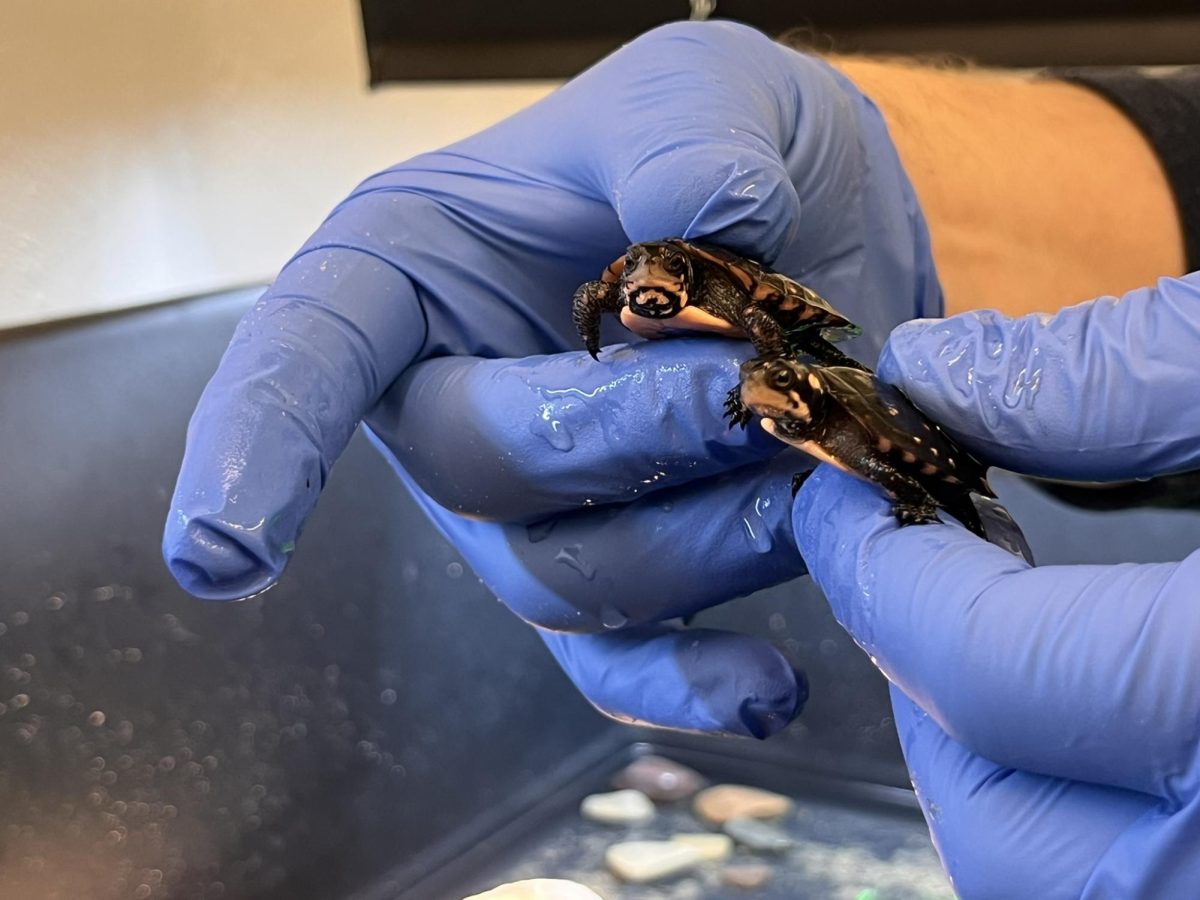
On Oct. 23, Calvin University welcomed 11 baby spotted turtles from John Ball Zoo as a part of a program aimed to strengthen the spotted turtle population in Michigan.
Spotted turtles are considered threatened in Michigan and protected under state law, according to the Michigan Natural Features Inventory. They are named for their spotted shells and are typically found around clean, shallow bodies of water surrounded by aquatic or emergent vegetation.
The program “is the latest addition to John Ball Zoo’s Great Lakes Rare Turtle Program, led by Bill Flanagan, the Zoo’s conservation manager,” according to the press release shared by Calvin’s Marketing and Communications department, and is the first of these programs to focus on spotted turtles, according to William Miller, associate professor of biology and the head of the turtle project.
Head starting
According to Miller, the process they have started with the turtles is called head-starting, a “technique where you take an animal out of its natural habitat, bring it into the captive setting, allow it to raise up, and then re-supplement the wild population using those captively reared species.” Turtles will hibernate in the winter, but in head-starting conditions, the turtles will be kept awake and fed. “The idea is to see if we can promote growth, so that when they go out into the wild, they are, ‘head-started’ and have the best chance for dealing with the pressures of the turtle world,” Miller told Chimes.
Spotted turtles face many pressures in the wild, including predation, habitat loss and being taken from the wild as pets. “Raccoon-mediated and predator-mediated egg predation and neonatal predation is very, very high,” Miller said. Jocelyn Nieze, a pre-veterinary medicine student involved in the project, told Chimes that “they are really cute,” so people like to take them from the wild as pets.
“By keeping them in the winter, we’re giving them a safe space to grow bigger, get more food instead of what they would find in a cold Michigan climate,” Nieze said. “And then the idea is next summer, they’ll be re-released right around where we found them or where their moms were.”
“It’s a rough world out there to be a baby turtle, so we are trying to see if keeping them in captivity and then releasing them can increase their survival rates,” Maia Peterson, an Environmental Science student who is on leadership for the Wildlife Society, said. Peterson explained that these turtles are being raised alongside a group of turtles in the wild, so they are “comparing and asking if this is helpful and successful.”
The turtles at Calvin
So far, the turtles have been “doing great,” Miller told Chimes. “Some of them started at five grams. Some of them were almost double that, ten, after a week or so of them getting acclimated, and last week, we’ve seen growth.” Miller explained that bringing the turtles to a new space, they expected some fluctuation in their weight and eating, but now “we saw their weight stabilize, and they’re growing.”
Nieze shared that daily, two people come down for around an hour to feed the turtles. Each turtle gets its own feeding tub, and they are provided with a variety of diets ranging from pellet food to bloodworms. The temperature of their enclosure is also checked daily. Once a week, they get their weight checked.
“They have cute little nail polish on the back, so you don’t mix that up. They also have what’s called a notch code, which they notch into the outer edge of their shells to identify them,” Nieze said. “And so you’re checking that, making sure all turtles are accounted for. We’re also doing just a quick little check that nothing looks wrong.”
Spotted turtles and academics
This project has created unique “opportunities for our conservation-oriented students to see conservation in action. And for our vet students to get the animal handling hours that they need for vet school,” Miller said. Nieze said that having the program has been very helpful for getting hours with exotic animals, which “can be very difficult to do.”
The turtles have brought in people from many disciplines on campus, with students from biology and pre-veterinary medicine, as well as students from the education department who are involved in their care, Nieze told Chimes.
The turtles may also be involved in the animal behavior class this spring, according to Miller. “The animal behavior course [is] in the middle of winter, and that’s difficult to have. So, we’re hoping to potentially integrate this project in with that,” Miller said. “There could be all kinds of interesting opportunities, particularly to study things like feeding behavior. It’s already clear that some of [the turtles] have different personalities.”
“It’s really interesting to see what kind of things turtles inspire in people,” Miller told Chimes. “I have yet to meet somebody who doesn’t love a turtle, and these have become a really great little project.”