


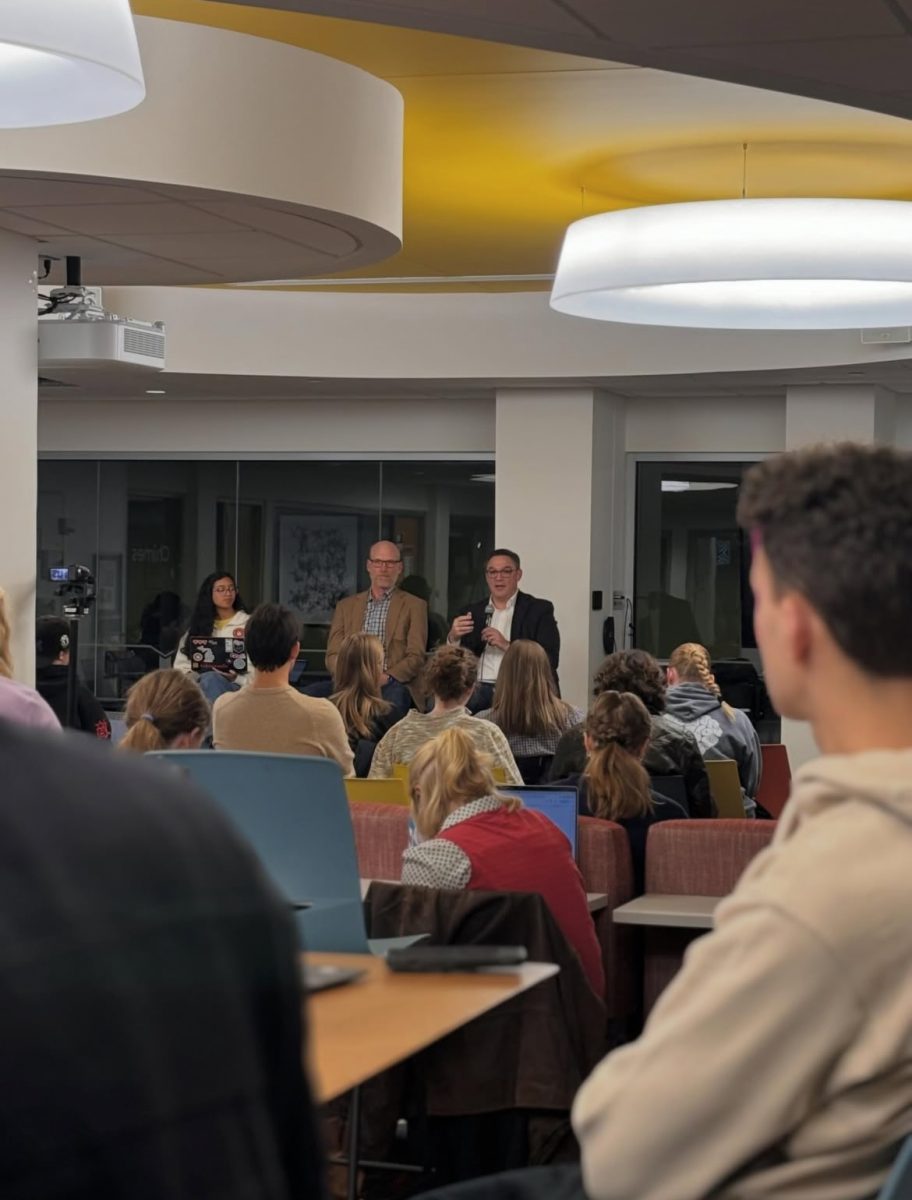
Following program and faculty cuts on Nov. 13, Student Senate hosted an academic transition town hall on Nov. 20 with Provost Noah Toly and Associate Provost Kevin den Dulk to discuss the changes.
This town hall was the second hosted by Senate with the intention of giving students the opportunity to ask questions in regards to academic changes at the university. The first town hall on Nov. 11 featured questions from students concerning “financial pressures, denominational directives and academics,” according to previous Chimes reporting. Senate requested that questions in the second town hall be more focused on the university’s academic transition.
The town hall drew a crowd of under 50 students, a significant decrease from the over 200 in attendance at the town hall the week prior.
How we got here
Initial questions and answers covered the context and process of the cuts announced to students on Nov. 13.
On the question of how Calvin pivoted from “invest to grow” to the “academic transformation,” Toly said, “We had invested in a certain amount of stimulus money … over a couple of years, and it had returned a lot of growth” but that “just because they were working in the aggregate doesn’t mean that everything was working. So some things had to be pulled back on and some things we are going to continue our investment in.”
Over the summer, administration realised Calvin’s enrollment numbers would be hit “because of federal immigration policies well beyond our control,” Toly explained. “It was clear we were not going to make the numbers we had budgeted on.”
The Portfolio Planning Sustainability Team (PPST) was tasked with making strategic cuts because “the revenue base got smaller, [the] expense base had to get smaller,” said Toly. The PPST, chaired by den Dulk, looked at all academic programs and “examined them for whether or not and how they were driving enrollment,” Toly continued.
One student asked how Calvin has promoted growth in smaller programs. Toly answered that “recent investments in the arts … have paid off” including growth in choral groups, crediting strategic investments and faculty innovation with the growth. In other cases, Toly pointed to departments that have “been as innovative as possible, and they still haven’t seen adequate growth in enrollment.”
In response to students concerned about Calvin losing its liberal arts identity, Toly replied that cuts were avoided in some “departments and programs that might have been adversely affected, had we not been considering our liberal arts identity and how essential they are to what we do.” Toly continued that “this was not just a numbers game. Had it been, it would have worked out quite a bit differently.”
As for the process and criteria for involuntary cuts of faculty, den Dulk noted that the process followed the guidelines set out in the faculty handbook, with “some leaving involuntarily as a result of a programming limitation, or involuntarily because they were still on the tenure track of not yet tenured.”
Toly explained that “there will actually be faculty added in some areas, [we] identified some areas where we’d have additional investments, some areas where we would be stable, and then some areas where we would trim our faculty. … In some of those cases, we have voluntary exits that helped us to trim the size of a program and in some cases, we had involuntary exits.”
When asked about whether the current cuts are the result of past overspending, Toly answered that “there isn’t one cause … there are some things we could have done better, some things we did really well, some things that are beyond Calvin’s control, all coming together.”
Students question new realities
Student questions also focused on reductions in course offerings and the low student-to-faculty ratio that Calvin prides itself on. den Dulk responded that reductions in faculty, even in departments that weren’t cut, could result in “a reduction in the number of sections offered.” Continuing specifically on class sizes, Toly said, “There isn’t a way to trim the expenses of the university without touching the things that affect class section size. So we expect some sections to get bigger.”
As for the student-to-faculty ratio, den Dulk added Calvin was committed to maintaining direct student to faculty relationships, and staying within the “15.1 to 15.4” range Calvin set in 2014, according to Toly. “We’ve been between 13.5 and 15.1 ever since,” said Toly.
When asked if programs that have been cut can come back, Toly responded that this would happen “only if it is strategic to do so,” noting the variety of programs that have returned after being cut, including music education and theater.
One question posed by a student asked whether they could “provide any assurance that these are the last cuts Calvin faces?” Toly pointed to the “volatility in the sector, which is the norm right now,” continuing that “we have to be adaptable … and that means a certain vulnerability to change.”
Students react with skepticism
Tannor Morgan, a senior studying philosophy and psychology with a neuroscience concentration, felt that this town hall went better than the previous one. Morgan explained that “I think for some of the questions, they felt fairly preplanned and just relatively safe, but I felt like — at least [from] what I heard compared to the last town hall — they did go in depth a bit more into some of the more nuanced parts of the cuts.”
Similarly, Sydney Stewart, a biochemistry and biology major, felt that “the answers were … supposed to be super positive — and a part of me hopes that that’s correct — but another part of me has serious doubt.”
Stewart emphasized the stress that faculty are feeling at this time, noting that “that stress … is impacting the way in which we’re taught.” Stewart continued that “the way in which the administration is responding has this kind of deceiving, positive outlook … it’s not congruent with the ways in which the faculty are continuing the ways in which they teach.”
Chantale Van Tassel, a senior studying linguistics, writing and Asian studies with a Japanese language focus, said of the decisions discussed at the town hall that “I do think that the metrics by which they are measuring and making their decisions are not the same metrics that we students care about, and that affects students. So, I think in that sense, we’re just operating on two very different planes of understanding of what’s important.” Van Tassel continued, “You have to decide what kinds of things are non-negotiably important. In the case of something like world languages, I think many students would advocate that that is a vital thing that is non-negotiable to keep, and that’s just something that I think we fundamentally disagree on, so that’s hard to hear.”
Sarah Logan, a senior studying philosophy, appreciated Toly and den Dulk’s “willingness to talk about things and to be a little bit more open than they have in the past.” However, Logan continued, “I think their answers are PR-mediated answers. I want answers that are real and admit to both successes and failures, [rather] than just whatever buzzwords we’re using to try to make everything sound better.” Going forward, Logan hopes that students and faculty can “have a voice, and not just this facade of a voice.”

