


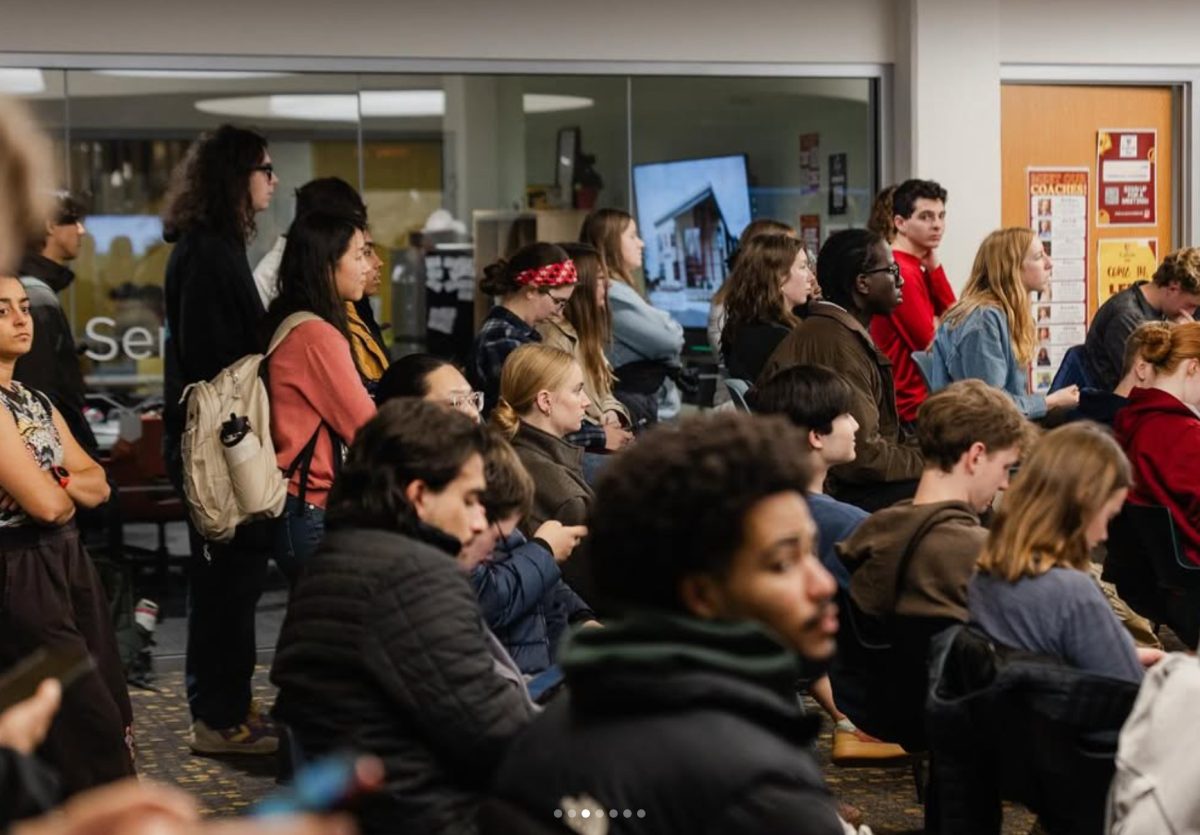
On the evening of Nov. 11, prior to the program cuts announced on Nov. 13, Student Senate hosted a town hall bringing together President Greg Elzinga, Provost Noah Toly, Executive Vice President for Student Experience and Strategy Sarah Visser and over 200 students in Commons Square to confront the financial pressures reshaping Calvin. Questions from students focused around financial pressures, denominational directives and academics, highlighting a sense of uncertainty.
Elzinga described national challenges including declining numbers of college-age students, rising costs and questions about the value of a four-year degree. “Every institution of higher education is wrestling and trying to figure out, right now, how do we embrace AI for teaching and learning, but also preparing you for a workplace in a world that is increasingly complex,” he said.
Provost Noah Toly added that Calvin plans to rebalance its liberal arts tradition toward “context and connections,” while Visser outlined a student experience task force grouping priorities into engagement and community life, care and wellbeing, and student success and pathways.
Students listening to the town hall voiced concern about transparency and the impact of program changes, and Calvin’s connection to the CRC church. Ellerie Poole, a French and English major, commented on the importance of Calvin’s variety of offerings: “The fact that Calvin not only had strong music, they had my athletic program, they had English, but they also had such a strong French program was probably one of the biggest reasons I chose to come here.” Today, Poole has been questioning what her future looks like at Calvin. On Nov. 13, the French major and minor were officially cut, according to an email from Elzinga.
Diego Herrera, an international student, attended the town hall and submitted a question to the administrative panel through SLIDO. He felt his question didn’t get a sound answer during the town hall and questioned the communication strategy, saying, “There hadn’t been much communication, and this felt like the one opportunity to have it. On the whole, it wasn’t very informative. I think beyond uninformative, it feels very dishonest.” Herrera continued to express his frustration: “I believe they could do a better job addressing and listening to their students and actually addressing their concerns instead of just jumping around.”
During the town hall, a student petition organizer, Isaac Nelson, promoted his effort to save Professor Joe Shin from termination as an adjunct philosophy professor. In an interview with Chimes, Nelson explained that a petition for one professor had been organized as a way to represent broader student concerns about faculty cuts. The petition was only in its early stages the previous Friday, but soon afterward students began hearing that dismissal emails had already been sent to professors. Nelson expressed his disappointment: “It was sad because once you start hearing professors are getting dismissed, it’s like, well, what did I even submit a petition for?”
Wei Xin, an international student, worked with Nelson to create the petition in hopes of keeping Shin at Calvin. Xin illustrated Calvin’s appeal from an international perspective but also how this has changed with time: “When I came to Calvin, one of the most beautiful things I discovered was that there can be a place of intellectual integrity… And then to see that immediately crumble is very crushing; it’s a kind of extinction.”
The night before the town hall, Xin talked to her co-petitioner Nelson: “I told Isaac [Nelson] what matters is that for the petition specifically, because it was written specifically for Shin but it was a symbol of broader gesture, of opposition to them cutting faculty.” Xin further commented: “For the petition, all we wanted at the end of the day, even in knowing it would be a defeat, was ultimately for our professor to feel that he had people standing with him, and that he had students who would want to fight for him in the way that he fights for us every day in the classroom to be better thinkers, to be the best of ourselves that we can be.”
Together, the students called out a gap between administrative reassurances and their lived experience. While leaders emphasised stability and long-term planning, students described frustration, disillusionment and a desire for greater transparency. Poole summarised the stakes: “Cutting the language department kind of shows that maybe we’re transitioning to a perspective where we don’t value those interpersonal connections as much. It’s absolutely crucial that we have this space to build those skills.”
Amidst an uncertain future, Poole called out to her fellow students: “My call to the student body is to get involved, and stay informed because I feel like a lot of people don’t even know this is happening. It’s important that we question our school’s values, it’s important that we stay involved. As students, I think we have an obligation to be involved in our own education and involved in the way things are run so that if we see something that isn’t reflecting our values and Calvin’s values and the values we know are so integral to this school, then I think we need to do something about it.”
Nelson noted that in all of the changes to Calvin’s academic division he will continue to lean and trust in God: “I’d go back to my faith, at least, trusting that God would lead in these circumstances, regardless if it’s a mistake — God uses all things for good.”

