


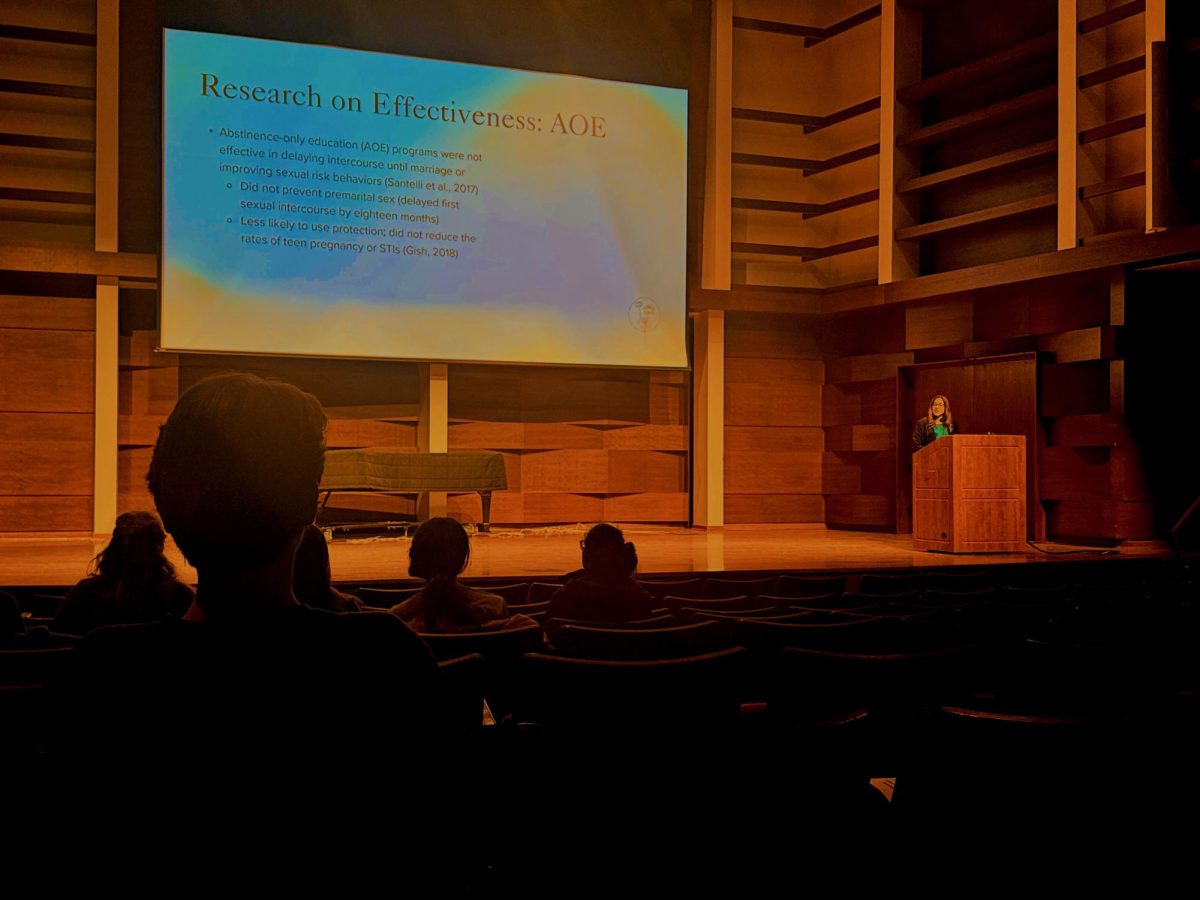
Thursday, Feb. 20, Calvin Sexuality Series and Sexual Violence Prevention Education Ambassadors at Calvin (SPEAC) co-hosted Dr. Camden Morgante, a clinical psychologist and sex therapist, to discuss her new book: Recovering From Purity Culture.
Morgante defined purity culture as “the myths, messages, and cultural movement to persuade people to avoid any sexual activity prior to marriage, often using and resulting in shame and fear as a method of control.”
Despite purity culture peaking in the 1990’s to 2000’s, Morgante noted that purity culture is prevalent in today’s society, even though her research has found it ineffective at accomplishing the goal of abstinence.
As illustrated in her book, Morgante highlighted five myths associated with purity culture: The Spiritual Barometer, The Fairy Tale, The Flipped Switch, The Gate Keepers, and the Damaged Goods, alongside their effects, and paired them with truth.
For instance, the Spiritual Barometer suggests that “Your worth, identity, and spiritual maturity, especially for women, is your virginity.” The effect of this is pride, and the truth to combat this is humility.
Morgante noted that these myths are bolstered by the evangelical culture of courtship, marriage and patriarchy, which inadvertently have negative effects on believers’ faith, sexuality and relationships. To rebuke these myths, she has constructed a five-step path to recovery for those who have been harmed by the negative effects of purity culture: 1) identify and change toxic beliefs, 2) make embodied changes, 3) overcome shame, 4) rebuild faith and sexual ethic and 5) advocate for change in our systems.
Morgante concluded in her book that purity culture isn’t Christian because it isn’t based in Scripture, and because of this, it creates adverse effects. As Jodi VanWingerden, Calvin’s coordinator for student support and sexuality programming, noted: “If something doesn’t produce good fruit, then how can it be of God?”
Staff & Students Respond
VanWingerden pointed out that in her position, she has noticed an increase of students who are entering college without being taught how to thoughtfully engage in conversations about sex and sexuality. “The result of that is that students just don’t have the information, and purity culture adds to that by putting a lot of value statements on being pure and has caused all kinds of damage along the way,” VanWindergen said. She explained that it is for these reasons that educators such as Morgante are hosted by Calvin’s Sexuality Series to cultivate a space for education and dialogue on important topics.
Esther Kratzer, a sophomore attendee, stated she attended the event because purity culture is “really an emotional, biological and psychological experience, and even for those whom purity culture may not be a personal experience, this culture is still relevant in our society.” She continued by expressing her appreciation to Calvin for providing such events. “It’s pretty cool to have this presented in an academic setting, because I feel like a lot of our association with intimate topics like sex are all private, and something you don’t talk about openly.”
Lilliah Engel, another sophomore attendee, noted her interest in attending an event about purity culture, illustrating its ubiquity to this day. ”I have heard a lot of those things said, there is a lot of shame surrounding that and I wanted to hear more about the research about purity culture and the myth that comes with it, which is people wanting to sustain the patriarchy.” She continued to call out this environment of silence when it comes to engaging in dialogue about sex in the Christian community. “Sex is a huge thing in life, and it’s a huge thing we don’t talk about … so why are we being weird about it?”
Vanwingerden emphasized the need to create a community where it’s okay to talk about sex and sexuality. “It just takes one person to like to say something and be like, okay, let’s talk about it,” Vanwingerden told Chimes. “The more you talk about [purity culture], the more normalized it becomes to talk about it, taking away the stigma and the awkwardness.” This is precisely the problem the Sexuality Series aims to address, by hosting experts such as Morgante to create a space where students can learn in spaces that promote understanding over silence.

