


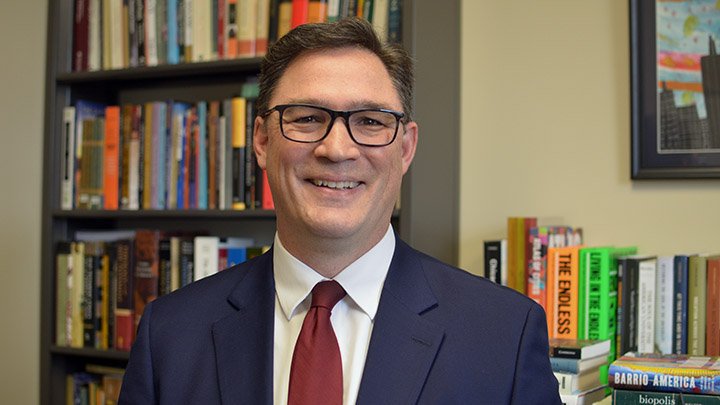
On Jan. 15, 2026, it was announced that Provost Noah Toly would be stepping down from his role after Commencement Weekend in May 2026.
Toly told Chimes that “this moment feels right for a leadership transition, both for me personally and for the institution … I’m excited that my next roles will allow me to continue contributing to Christian higher education on a broader scale.” His new roles, with institutions outside of Calvin, will focus on advancing the values of Christian higher education in new contexts through “collaboration with institutions on faith, learning and building trust with their publics.”
Looking back
Kumar Sinniah, professor of chemistry and biochemistry, as well as co-chair of the search committee that hired Toly, told Chimes that when Toly was hired, they were looking for a provost who would be “actively engaged with faculty, administrators and governance bodies” to help rebuild low morale and momentum after a long period of academic prioritizations. The committee also found it important that the provost “embody a posture of service” and would place the well-being and mission of the community central to their leadership.
“Noah appeared to be a good fit for that moment, especially as he followed Provost Cheryl Branden, who was widely respected across campus,” Sinniah said. David Urban, professor of English, echoed that sentiment and said that he has appreciated how Toly “has supported faculty scholarship” and how he had “genuinely listened respectfully to all perspectives.”
Toly described his time at Calvin as a “season defined by collaboration” and expressed his appreciation for how every person he has worked with has enriched his professional and personal life. “I witnessed remarkable resilience and adaptability as we navigated major shifts in higher education. It has been especially encouraging to see Calvin strengthen both its liberal arts — investments in the arts have been meaningful — and professional programs, affirming its identity as a Reformed Christian university committed to academic excellence and institutional clarity,” Toly said.
Sinniah explained that one of the early challenges Toly faced at Calvin was navigating its shared governance culture. “While some faculty and administrators adjusted more easily to this difference in style, others experienced it as a departure from Calvin’s long-standing collaborative approach,” Sinniah told Chimes. Sinniah felt that this challenge contributed to “perceptions among some faculty of reduced transparency and, more broadly, to a sense of strained trust between faculty and senior administration.”
Something Toly said he was particularly proud of in his time at Calvin was how the Senior Academic Leadership Team “has worked with faculty and others to enhance Calvin’s already strong academic reputation” while supporting enrollment growth and institutional stability. “We have advanced a clear and compelling vision that brings together the best of Christian liberal arts education with outstanding professional pathways,” Toly said.
Many of these initiatives, particularly the introduction of postdoctoral positions, were received positively according to Sinniah, while others, like the transition to a four-two credit model from a three credit model were not. “Many faculty believed the curricular change might have worked better had departments been given more time and space to reimagine their programs rather than repackage existing content under significant time pressure,” Sinniah said.
Another defining aspect of Toly’s tenure “was his significant focus on denominational issues, particularly those related to human sexuality and Calvin’s relationship with the Christian Reformed Church in North America (CRCNA),” according to Sinniah. “His desire to align Calvin more closely with the denomination resonated with some faculty and staff, who viewed this as an important reaffirmation of institutional identity,” Sinniah told Chimes. “At the same time, others experienced this period as deeply challenging. Some faculty were concerned about the implications for academic freedom and for Calvin’s ability to remain a welcoming and supportive environment for LGBTQ+ students, faculty and staff.” According to Sinniah, this left many with a feeling of the “messy middle” and questioning if Calvin was moving away from its practice of living faithfully.
Urban highlighted Toly’s navigation of two presidential transitions, one completely unexpected, and Toly’s “graceful” handling of personal attacks that came out in the second transition as something that stood out to him about Toly’s leadership. Urban also highlighted Toly’s dedication to building and being a part of the community, sharing a memory of an event hosted at the Toly’s home for CORE 100 faculty “in which we graded final exams while simultaneously enjoying a Christmas party.”
Moving forward
Alongside the announcement of Toly’s stepping down, it was announced via a press release from President Greg Elzinga that Kevin den Dulk, current associate provost, would be stepping into the role of interim provost. den Dulk said that he hopes “to bring a fresh eye to the student experience and to faculty and staff engagement in Calvin’s big mission.”
“Our community has experienced a great deal of change over the past decade. Some of that change has brought exciting new opportunities for learning and new kinds of students, and I’ve been energized to be part of that work,” den Dulk told Chimes. “But I also know that many have experienced change as loss, and I feel that too. I step into this role with a deep love for Calvin’s mission and a recognition that growth and transition always come with real costs.”
den Dulk told Chimes that he is eager to work with faculty and staff to “strengthen the ways we collaborate and make decisions together” and that he found that work “crucial to building a healthy culture at a place as complex and mission-driven as Calvin.” He also said that he felt it was part of his responsibility “to create the conditions for my successor to lead well, to leave space for focus, creativity and trust.”
Sinniah told Chimes that he thought “rebuilding trust and lifting faculty morale will be essential,” and to do that, the next provost will need to be “a strong listener and consensus builder who values partnership with faculty and recognizes that faculty and staff are among Calvin’s greatest assets.” Sinniah explained that three recent Best Christian Workplace Institute surveys indicated very low levels of trust in leadership at Calvin and “a genuinely collaborative partnership with faculty will go a long way toward repairing that trust deficit and rebuilding Calvin’s institutional strength and reputation.”
Sinniah emphasised the importance of supporting whoever steps into the provost role next. “Leadership at that level can be isolating, and a thoughtful transition process supported by a strong team and trusted colleagues can make a significant difference in setting a new provost up for success at Calvin.”


Hongqi Fan • Mar 7, 2026 at 9:07 am
I wonder where Calvin will be 5 or 10 years from now. Pray!