


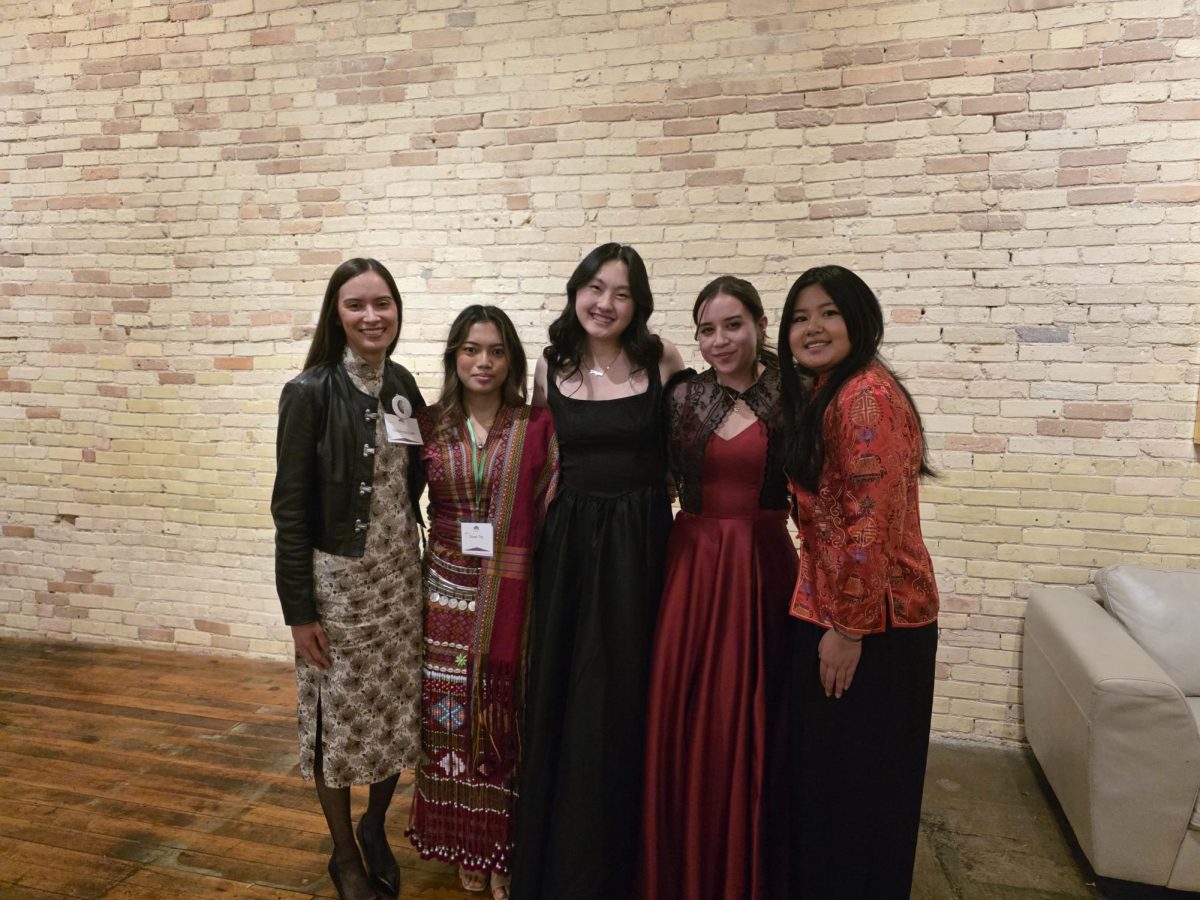
On Oct. 22, several Calvin students and a number of faculty members attended the annual Asian Gala hosted by West Michigan’s Asian American Association (WMAAA). This event, sponsored in part by Calvin, celebrated its fifteenth anniversary this year. According to WMAAA’s website, the gala is held to celebrate “the diverse and talented Asian American professionals in West Michigan,” and “deepen… connections to the local community,” of which Calvin students are a part. Chimes sat down with leadership from WMAAA and Calvin’s Asian American Association (AAA, pronounced “triple A”) to discuss what it means to be Asian American at Calvin and beyond.
English professor Sabrina Lee understands Asian American identity as highly complex. “If you think of the term Asian, that covers so much of the world,” she said, “And then combine it with American; there’s so many different pathways to immigration.” After graduating from Calvin in 2013, Lee got a graduate degree in English and a minor in Asian American Studies, where she learned how capacious the Asian American experience can be. It encompasses countless identities — immigrants, children of immigrants, children of immigrants’ children, adoptees, individuals of mixed-race … the list goes on. Lee sees Asian Americanness as inherently plural; to her,“[that’s] the beauty of the term, because it can be so welcoming.”
In many ways, Calvin’s landscape exemplifies this plurality. “Calvin has such a unique Asian community,” explained AAA president Grace Moon. Calvin’s Asian population is “not all Asian Americans; there’s actually a lot more international students,” said Moon. She appreciates this makeup, yet also understands how it can blur the lines distinguishing identity. “For me, as a Korean American,” Moon explained, “I’m not Korean enough to hang out with Korean people but then… I don’t feel that American [either] … I’m also a very different case because I have lived abroad also, so I have a lot of different experiences.”
“I know there are [other Asian] international students who grew up in the states and also grew up internationally,” Moon added. Calvin is uniquely home to many of these third culture kids, students who were raised in a culture different than their parents’. Often, like Moon, their parents’ involvement in the church moved them around growing up, making their cultural identity increasingly complex.
Likewise, both Moon and Lee recognize that Calvin’s student body includes a large number of transracial adoptees. Moon emphasized the value of their experience as another facet of what it means to be Asian American.
AAA doesn’t overcomplicate, but rather celebrates these distinctions. “I feel like sometimes [claiming Asian American identity] is daunting because [students] don’t feel like they’re Asian enough,” Moon said. “I think that’s a struggle that a lot of Asian Americans feel alone in, but I want to make sure that AAA can be a place that they can come to.” Moon’s message is simple: “It doesn’t matter how you identify as Asian American, you are still Asian American, and we would love to have you here.” Although AAA did not exist when Lee, who is of mixed Chinese descent, attended Calvin, she echoed Moon’s view: “I think I would have wondered if I were Asian American enough when I was a student.” To current students who might be asking similar questions, Lee says, “yes, you are more than enough.”
And so, AAA this year is all about building community. “Anybody’s welcome,” said Moon. “Especially if you feel you don’t quite fit in with your cultural group.” This year, AAA launched its new family groups. Created to offer students more flexibility and make gatherings less intimidating, members will now meet in smaller, more casual settings. Part of these family meetings will include a meal with a faculty member. “The idea is that students can get to know Asian American faculty on a less formal basis,” explained Lee. To AAA, this visibility is key to belonging. After all, according to Moon, “AAA is more so a community than it is an actual organization.”
AAA also has ties to the wider Asian and Asian American communities, especially WMAAA. Co-founder Bing Goei has deep roots with Calvin. “There is a real close relationship and a strong synergy between Calvin’s vision for its Asian and international student population with WMAAA’s vision for inclusion and visibility and lifting up the voices of the Asian American population,” Goei said. The nonprofit and the school formed a partnership several years ago that Goei described as “aligned on the value of diversity.”
Goei, an Indonesian-born immigrant, former city council member and local business owner, has been living in Grand Rapids since 1960. His three daughters attended Calvin, and he has long been an advocate of the school’s Asian students, explain Moon and Lee. “20 years ago… I was basically the one Asian person that everybody calls on to serve on boards and committees [in West Michigan],” Goei recalled. As a part of WMAAA, Goei hopes to strengthen representation so that young people today do not face the same conditions.
As a nonprofit, WMAAA works to address the needs of West Michigan’s Asian community. Their work includes healthcare navigation and workforce development. An emerging focus, however, is nurturing younger generations. WMAAA recently hired a new executive director, Dr. Yilin Wendland-Liu. According to Goei, she is “committed to bringing in more voices from [the younger] generation to guide and lead us as an organization.”
Part of this can be seen in the creation of WMAAA’s new youth advisory committee. Composed of several college-age Asian individuals living in the area, this nascent board’s goal will be to improve intergenerational connections. With their alternate perspectives, Goei and the rest at WMAAA are hoping the committee will “guide [WMAAA] into activities that will make [West Michigan’s] Asian and international students who are not part of this community feel like they belong.” This inevitably means Goei will be stepping away from some of his leadership responsibilities at WMAAA. But he considers this move fundamental to the community’s success. “I’ll be around and you can ask me for input,” he explained, “but I can’t take a leadership role because that prevents someone younger from taking a leadership role.”
Goei also anticipates this year’s International Leadership Summit. Conceived in 2024, the summit is a networking event for Asian international and Asian American college students throughout West Michigan.
Inspiration for the summit came from conversations Goei had with Asian Calvin students several years ago. “[I found] there is a sense of loneliness for these folks,” Goei remembered. “They said to me, ‘We don’t see anyone that looks like us in any positions of authority, influence, power [in West Michigan]. There’s no spokesperson that’s Asian in this community.’ For them, that meant that this community does not value their input. And they said, ‘Then why do we want to stay here?’”
In this way, the International Leadership Summit was born as a response to these student retention issues. “We want[ed] to showcase and highlight successful Asian leaders, both community and business leaders, to the students who are studying in West Michigan, to say ‘Maybe you didn’t see these folks, but they’re here,’” said Goei. So two years ago, students from Asian affinity groups at Calvin, Hope, Ferris State and Grand Valley were invited to hear a panel of all-Asian keynote speakers and predominantly Asian workshop leaders. Goei counted the inaugural events a success. “Calvin was a big part of that,” he added.Both WMAAA and AAA at Calvin envision a future where their Asian communities are connected and engaged. When asked to step in as faculty advisor for AAA, Lee responded enthusiastically. “I want to support students in helping them create belonging,” she told Chimes. Whether through family group meetings or business-oriented workshops, these opportunities for belonging are all around.

